
Material Standards and Composition
Square steel pipes and rectangular steel tubes are manufactured from specific steel grades to meet structural and mechanical requirements.The yield strengths of common carbon steel grades are ranging from 235 MPa to 355 MPa.The chemical composition of the product is strictly regulated, with carbon content typically ranging from 0.16% to 0.22%, manganese between 0.45% and 0.65%, and sulfur and phosphorus levels maintained below 0.045%.
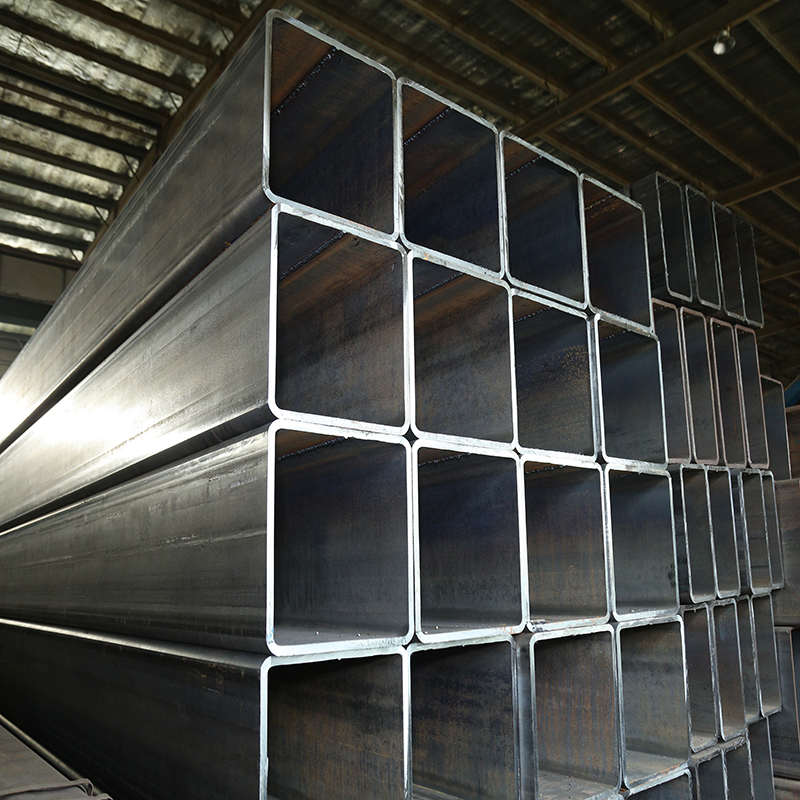
For requiring corrosion resistance applications,hot-dip galvanizing is the preferred choice .The zinc coating is generally applied at a minimum of 275 g/m²,which is equivalent to roughly 60 μm in thickness. This guarentees durability and sustained performance, especially in outdoor environments.
Manufacturing Process
Square and rectangular tubes are manufactured through two main forming techniques. The direct forming process (FRF) is particularly suitable for high-strength steels. During this process, a flat steel strip passes through 10–12 roller stations, gradually forming the rectangular profile before high-frequency welding. This method achieves tight dimensional tolerances, typically ±0.3 mm.
The circular-to-rectangular forming method (CRF) starts by forming a circular tube then is shaped into a rectangle. Although this approach is effective for standard applications, it is less suitable for high-strength steels due to springback issues.
Welding parameters are carefully monitored. High-frequency welding operates between 200–400 kHz, resulting in a minimal heat-affected zone. In certain instances, post-weld heat treatment is applied to standardise the weld seam microstructure, ensuring that mechanical properties are consistent with the base material.

Quality Control and Testing
Dimensional checks include:
Outer dimensions: ±0.5% for commercial grade, ±0.3 mm for precision grade
Wall thickness variation: within ±10% of nominal thickness
Straightness: up to 0.5 mm per meter
Mechanical testing typically verifies:
Tensile strength and yield strength according to standards
Bend tests to confirm ductility
Charpy V-notch impact tests for low-temperature applications
Application-Specific Recommendations
For structural frameworks, Q355B tubes made with the direct forming process provide a strong and cost-effective solution. Equipment handling applications that require higher impact resistance often use Q355D. For architectural projects, galvanized Q235B is suitable for indoor use, while outdoor structures benefit from galvanized Q355B.
The choice of manufacturing method directly affects product performance. Direct-formed tubes generally offer better dimensional accuracy and mechanical consistency, which is critical for high-strength applications with tight fabrication tolerances.

TIANJIN YUANTAI DERUN PIPE MANUFACTURING GROUP CO., LTD
