
Hydrogen Pipeline Standards and Steel Selection
As the global energy transition accelerates, hydrogen has emerged as the definitive frontier for a carbon-neutral future. However, the "Hydrogen Economy" is only as strong as the infrastructure that supports it. In 2026, the industry has reached a pivotal turning point: moving away from experimental pilot projects toward standardized, large-scale long-distance pipeline networks.
Transporting hydrogen isn't just a change in medium—it is a fundamental shift in material science. Success requires a rigorous approach to the technical demands of steel selection and a deep understanding of the current regulatory landscape.
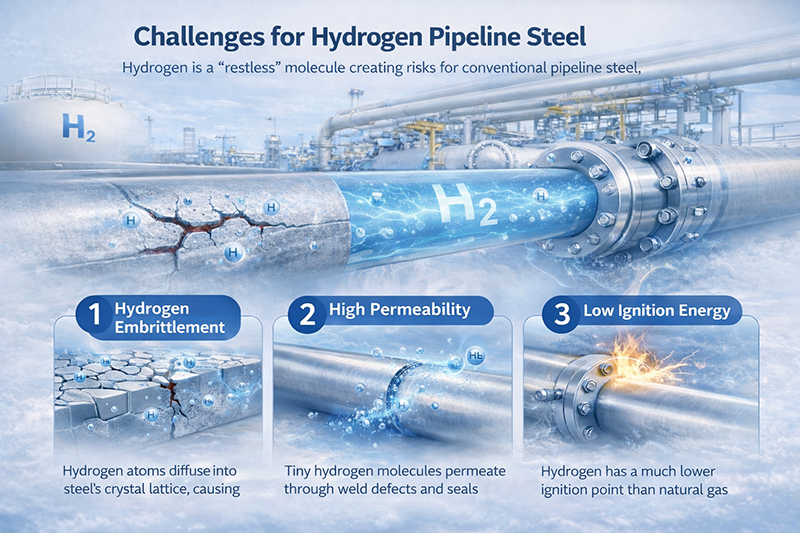
Hydrogen is a "restless" molecule. Its unique physical and chemical properties create a hostile environment for conventional pipeline steel through three primary mechanisms:
● Hydrogen Embrittlement (HE): The most critical threat. Atomic hydrogen diffuses into the steel’s crystal lattice, accumulating at grain boundaries. This causes a drastic loss in ductility, turning tough steel into a brittle material prone to sudden, catastrophic failure.
● High Permeability: Hydrogen is the smallest element. It can permeate through seals, microscopic weld flaws, and even the metallic structure itself at a rate significantly higher than methane.
● Low Ignition Energy: With an ignition point nearly 10 times lower than that of natural gas, any localized heat from friction, static, or minor leakage poses an immediate fire and explosion risk.
The Verdict: Hydrogen pipelines must be designed for absolute compatibility, not just pressure containment.
For years, many nations relied on adapted oxygen or industrial gas standards. However, as of early 2026, the regulatory vacuum has been filled with specific, robust frameworks.
● National Breakthroughs: The release of specialized standards, such as GB/T 34542.5 (2026)—"Technical Requirements for Hydrogen Storage and Transportation Systems"—has finally provided a unified legal framework for long-distance hydrogen transmission.
● International Alignment: Modern standards now align closely with ASME B31.12 (North America) and EIGA/CGA guidelines (Europe), focusing on "Material Performance Factors" rather than just static safety margins.
When selecting steel for hydrogen pipelines, the traditional "higher is better" logic for steel grades is reversed. In the world of hydrogen, lower strength often equals higher safety.
While natural gas lines frequently use X70 or X80 high-strength steel to reduce wall thickness, hydrogen service favors:
● API 5L L245 / X42
● API 5L L360 / X52
Why? High-strength steels are far more susceptible to hydrogen-induced cracking. Lower-grade steels (X42/X52) possess a more stable microstructure that better accommodates hydrogen atoms without losing integrity.
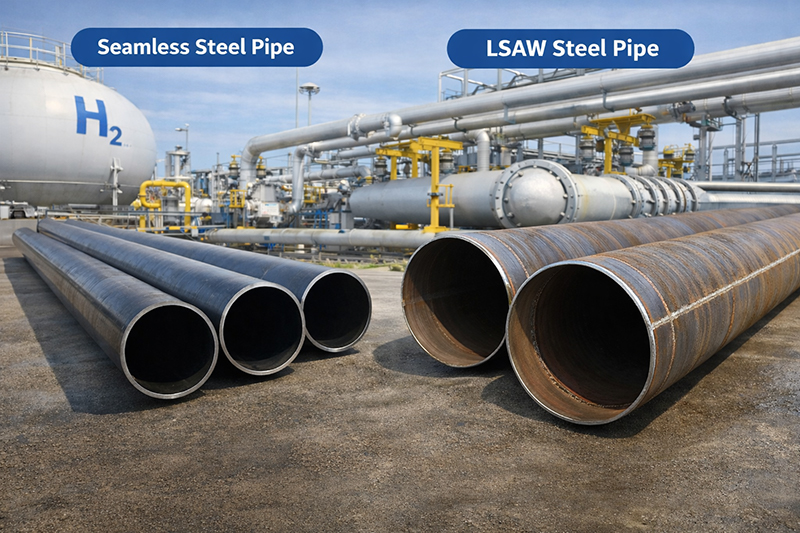
● Seamless Steel Pipe (SMLS): Remains the "Gold Standard" for high-pressure hydrogen service (above 10MPa), as it eliminates the weld seam—the most common point of failure.
● LSAW/ERW Welded Pipe: Necessary for large-diameter long-distance lines. However, the Hardness Limit is the non-negotiable metric. In 2026, standards mandate that both the base metal and the Heat Affected Zone (HAZ) must not exceed 22 HRC (250 HV) to prevent embrittlement.
C. Chemical Purity: The "Clean Steel" Requirement
Modern hydrogen steel requires a specialized chemical profile:
● Ultra-Low Sulfur and Phosphorus: To minimize non-metallic inclusions (like Manganese Sulfide) that act as "hydrogen traps."
● Carbon Equivalent (CEV) Control: Lower CEV values ensure superior weldability and prevent the formation of hard, brittle martensite in the weld zone.
A major takeaway from the 2026 standards is the adjustment of the Design Factor (F).
In natural gas pipelines, a design factor of 0.72 is common. For hydrogen, this is often throttled down to 0.4 or 0.5. This "conservative" approach forces an increase in wall thickness (often 20%–40% thicker than gas lines) to compensate for the potential 10%–30% degradation of material properties in hydrogen environments.
Building the hydrogen highways of 2026 and beyond requires a holistic understanding of Material-Hydrogen Compatibility. From the move toward Austenitic Stainless Steels in critical valve sections to the development of internal anti-permeation coatings, the industry is evolving rapidly.
As large-scale hydrogen corridors begin construction, the synergy between rigorous steel selection and updated national standards will be the bedrock of a safe, efficient, and profitable green energy future.

TIANJIN YUANTAI DERUN PIPE MANUFACTURING GROUP CO., LTD
