
In international procurement and project bidding, contractors frequently ask a dangerous question: "They are both carbon steel, so can’t we just take standard fluid pipe, paint it red, and use it for the fire sprinkler system?"
The short answer is absolutely not. Doing so is laying a landmine in your building’s infrastructure.
While a standard steel pipe and a fire sprinkler pipe may share the same metallurgical "DNA," their operational realities are entirely different. A fire system sits dormant for 99% of its life, yet it must perform flawlessly under immense pressure the very second a crisis hits.
Here is a technical look at the strict industrial processing required to transform raw carbon steel into a certified, life-saving fire protection asset.
Standard pipes are engineered for continuous fluid transport. Fire pipes, however, must combat two extreme challenges: long-term static corrosion and instantaneous pressure surges.
The Internal Scaling Threat: In a fire system, water sits stagnant for years. Unprotected standard steel will inevitably suffer from Microbiologically Influenced Corrosion. When the system finally activates, these internal rust flakes will rush to the end of the line, completely clogging the delicate spray nozzles.
Seismic and Thermal Stress: Standard threaded or welded joints are rigid. During a fire, buildings experience thermal expansion and structural shifting. Rigid joints on standard pipes are prone to brittle failure precisely when water is needed most.
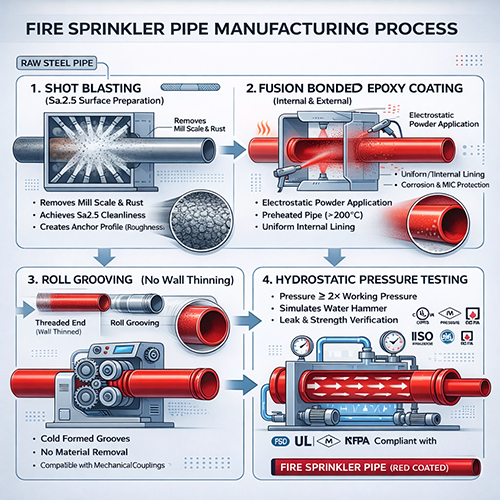
To guarantee a pipe won't fail during an emergency, it must undergo a specialized "hardening" process at the mill. Here are the four non-negotiable processing steps:
You cannot simply apply paint over mill scale. The raw pipe is first fed into a high-velocity shot-blasting chamber.
The Engineering Logic: The abrasive impact strips away all oxidation and impurities, bringing the steel to a Sa2.5 cleanliness grade. This creates a micro-rough profile, ensuring the subsequent coating bonds at a molecular level so it will never peel or flake.
This is the most critical upgrade. The pre-heated pipe (around 200°C) is subjected to an electrostatic application of modified heavy epoxy powder on both the internal and external walls.
The Engineering Logic: This is not just for the iconic "Signal Red" visual identification. The internal epoxy lining creates an incredibly smooth, frictionless barrier. It completely isolates the steel from stagnant water, effectively prevents MIC problem and ensuring water reaches the sprinkler heads instantly.
Instead of cutting threads into the pipe ends—which thins the steel wall and creates a weak point—fire pipes undergo automatic Roll Grooving.
The Engineering Logic: Grooving simply displaces the metal without removing it, maintaining the pipe's full structural integrity. This allows contractors to use mechanical couplings, resulting in a flexible joint that absorbs vibration and structural shifts without bursting. It also drastically reduces on-site installation time.
Standard fluid pipe testing is insufficient for fire safety.
The Engineering Logic: Every single processed fire pipe must pass a hydrostatic test at more than double its standard working pressure. This simulates the violent "water hammer" effect that occurs the second massive fire pumps kick online.Only products manufactured under certified systems and verified by hydrostatic testing are eligible to meet UL, FM, and NFPA requirements.
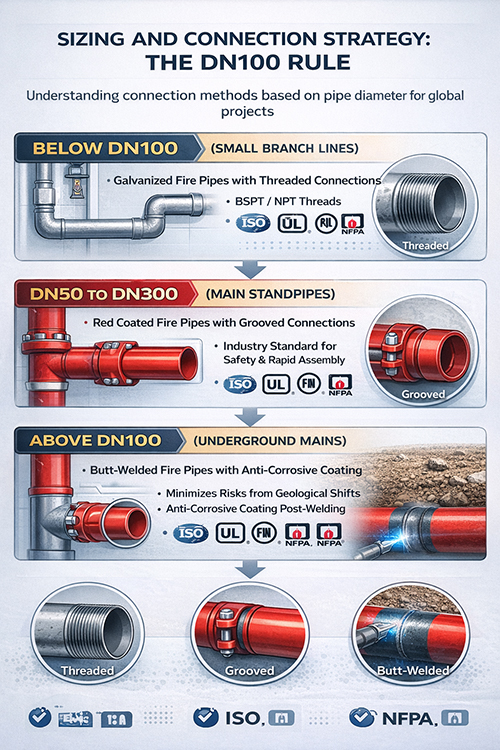
When procuring for a global project, understanding connection standards based on pipe diameter is crucial for both compliance and cost-control:
Below DN100 (Small Branch Lines): Galvanized fire pipes with threaded connections are frequently used.
DN50 to DN300 (Main Standpipes): Grooved connections are the absolute industry standard. They offer the best balance of safety, seismic flexibility, and rapid assembly.
Above DN100 (Underground Mains): Butt-welding is highly recommended to prevent leaks caused by geological subsidence, provided the weld seams are rigorously treated with anti-corrosive coatings post-installation.
When you purchase fire sprinkler pipe, you are not just buying tons of steel; you are investing in the certified processing that keeps the pipe alive during its decades of dormancy. Opting for a manufacturer that controls the entire transformation—from shot blasting to final epoxy curing—is the only way to ensure your infrastructure will pass inspection and protect lives when it matters most.

TIANJIN YUANTAI DERUN PIPE MANUFACTURING GROUP CO., LTD
